
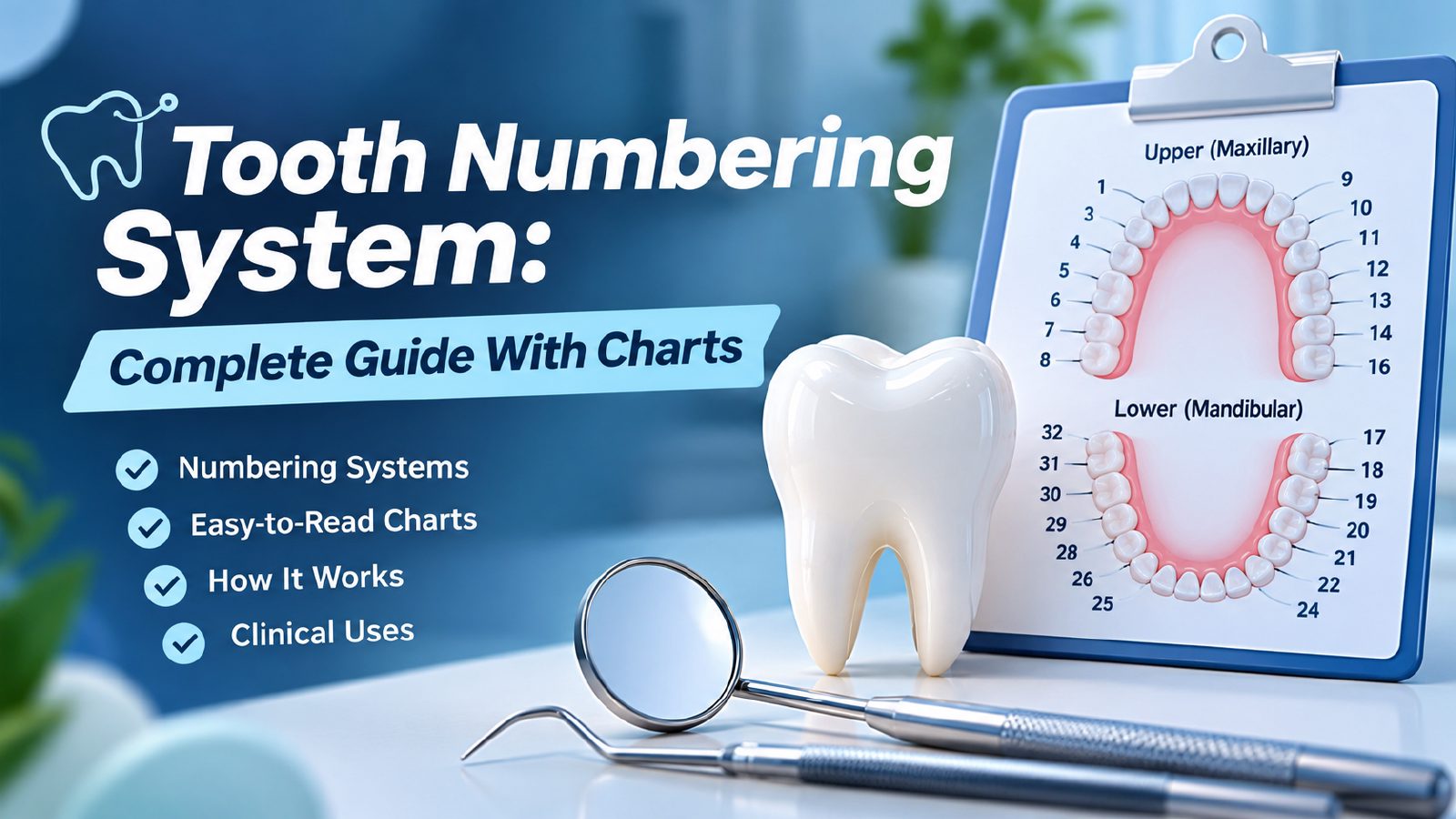
A tooth numbering system gives every tooth in the mouth its own short code, so a dentist, an assistant, a lab, and an insurer all mean the same tooth. Three systems are in use: FDI, the two-digit system used internationally and in the Philippines, Universal, the 1 to 32 system used in the United States, and Palmer, which pairs a number with a bracket.
The same tooth carries a different code in each. The lower left first molar is 36 in FDI, 19 in Universal, and ┌6 in Palmer. That is why a chart is only safe to read once you know which system wrote it.
This guide gives you the charts for adult and baby teeth in all three systems, a full conversion table, a quick way to convert in your head, and the mistakes that put a filling on the wrong tooth.
FDI Tooth Numbering Chart
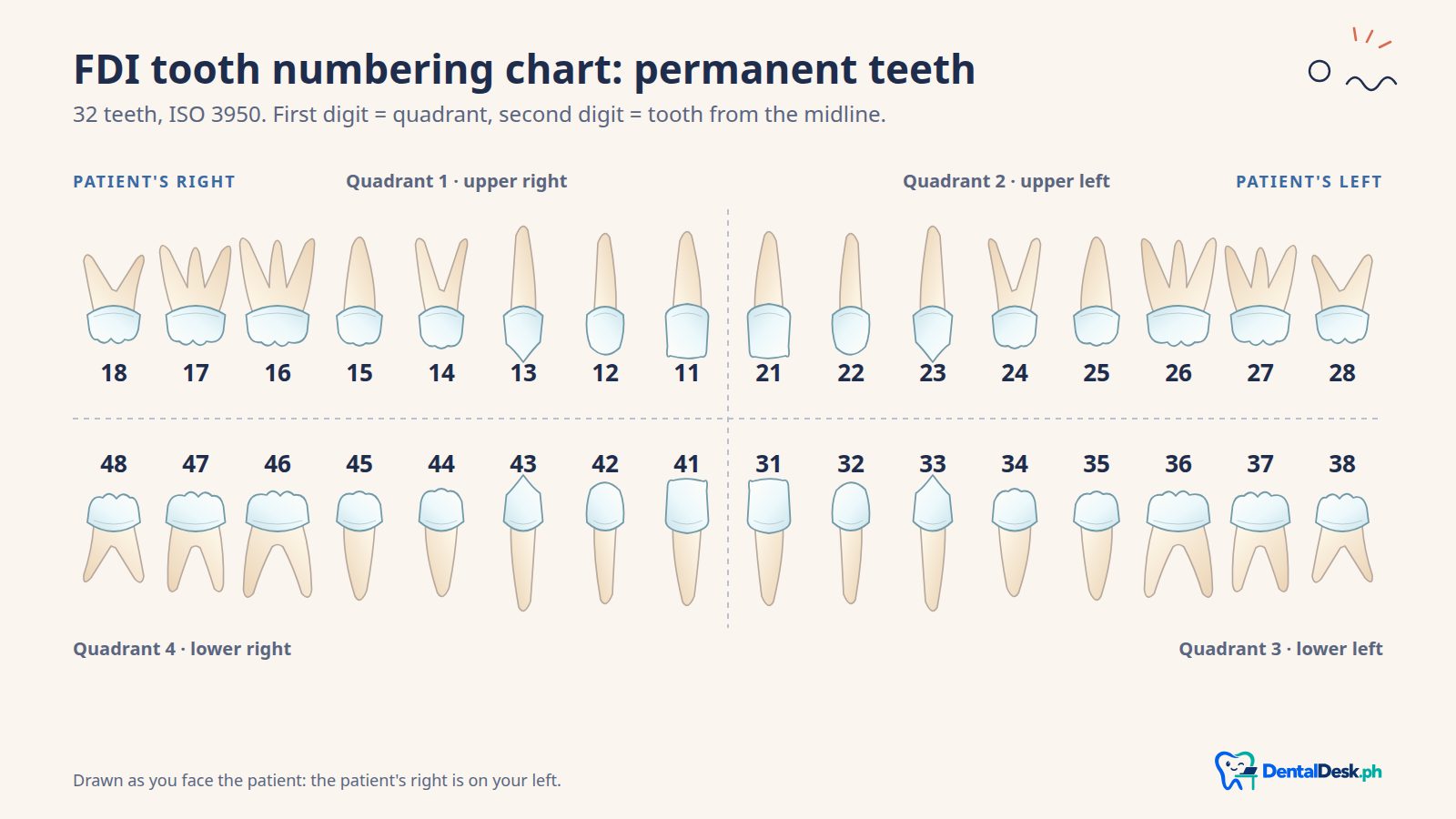
The FDI system, named after the FDI World Dental Federation, is the international standard for naming teeth (ISO 3950). Every tooth gets two digits: the first is the quadrant, the second is the tooth, counted from the midline.
Permanent Teeth
An adult has 32 tooth positions, 8 in each quadrant. The chart is drawn as you face the patient, so the patient's right is on your left.
| Patient's right | Patient's left |
|---|---|
| Quadrant 1, upper right | Quadrant 2, upper left |
| 18 17 16 15 14 13 12 11 | 21 22 23 24 25 26 27 28 |
| 48 47 46 45 44 43 42 41 | 31 32 33 34 35 36 37 38 |
| Quadrant 4, lower right | Quadrant 3, lower left |
The quadrants run clockwise as you look at the patient: 1 upper right, 2 upper left, 3 lower left, 4 lower right. Not every patient has all 32 teeth, but every position keeps its number.
Primary (Baby) Teeth
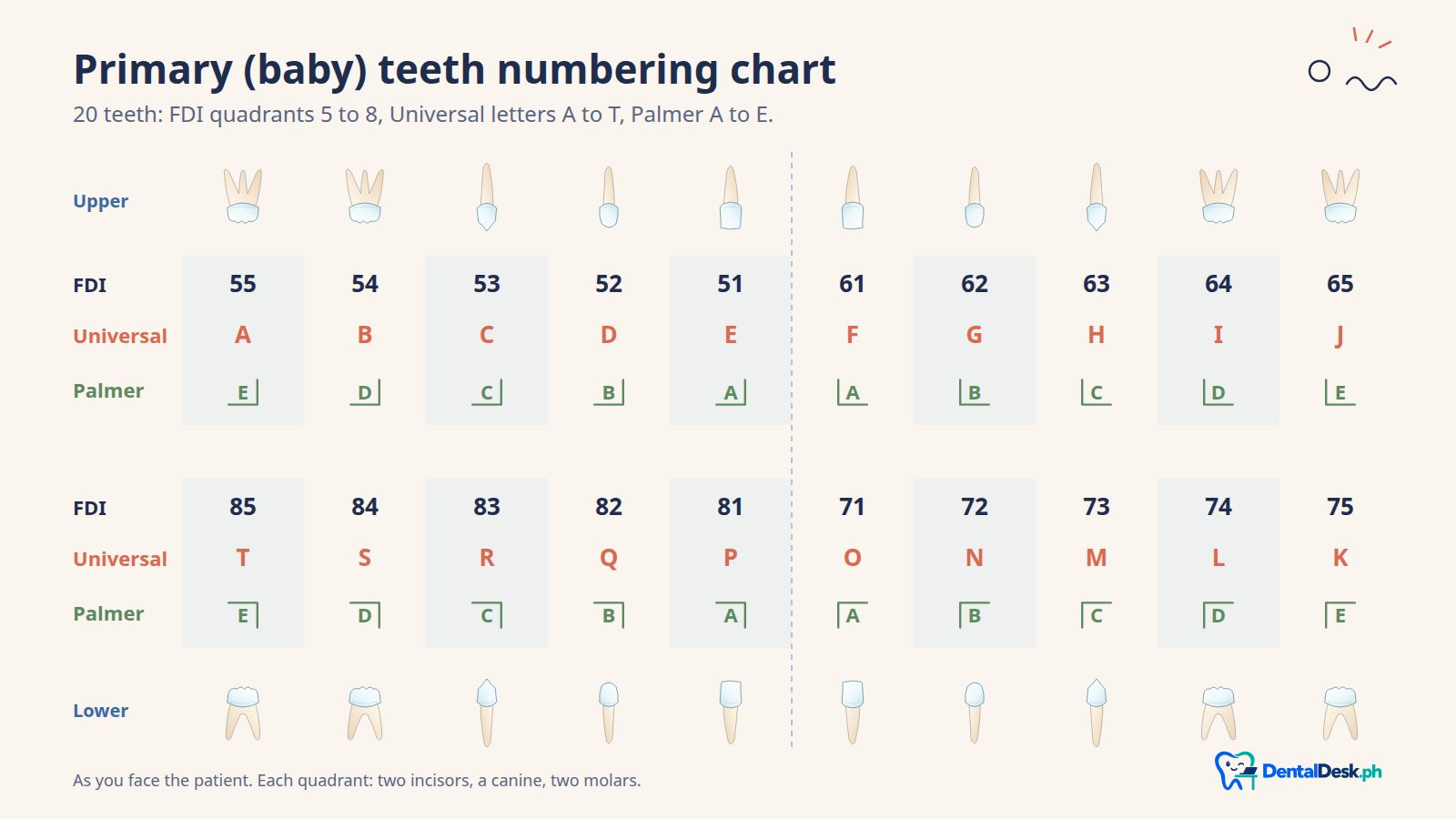
A child has 20 primary teeth, also called baby, milk, deciduous, or temporary teeth. FDI gives them quadrants 5 to 8, in the same clockwise order, with five teeth in each.
| Patient's right | Patient's left |
|---|---|
| Quadrant 5, upper right | Quadrant 6, upper left |
| 55 54 53 52 51 | 61 62 63 64 65 |
| 85 84 83 82 81 | 71 72 73 74 75 |
| Quadrant 8, lower right | Quadrant 7, lower left |
Each primary quadrant has a central incisor, a lateral incisor, a canine, a first molar, and a second molar. There are no primary premolars: the permanent premolars later erupt where the primary molars were.
How to Read an FDI Tooth Number
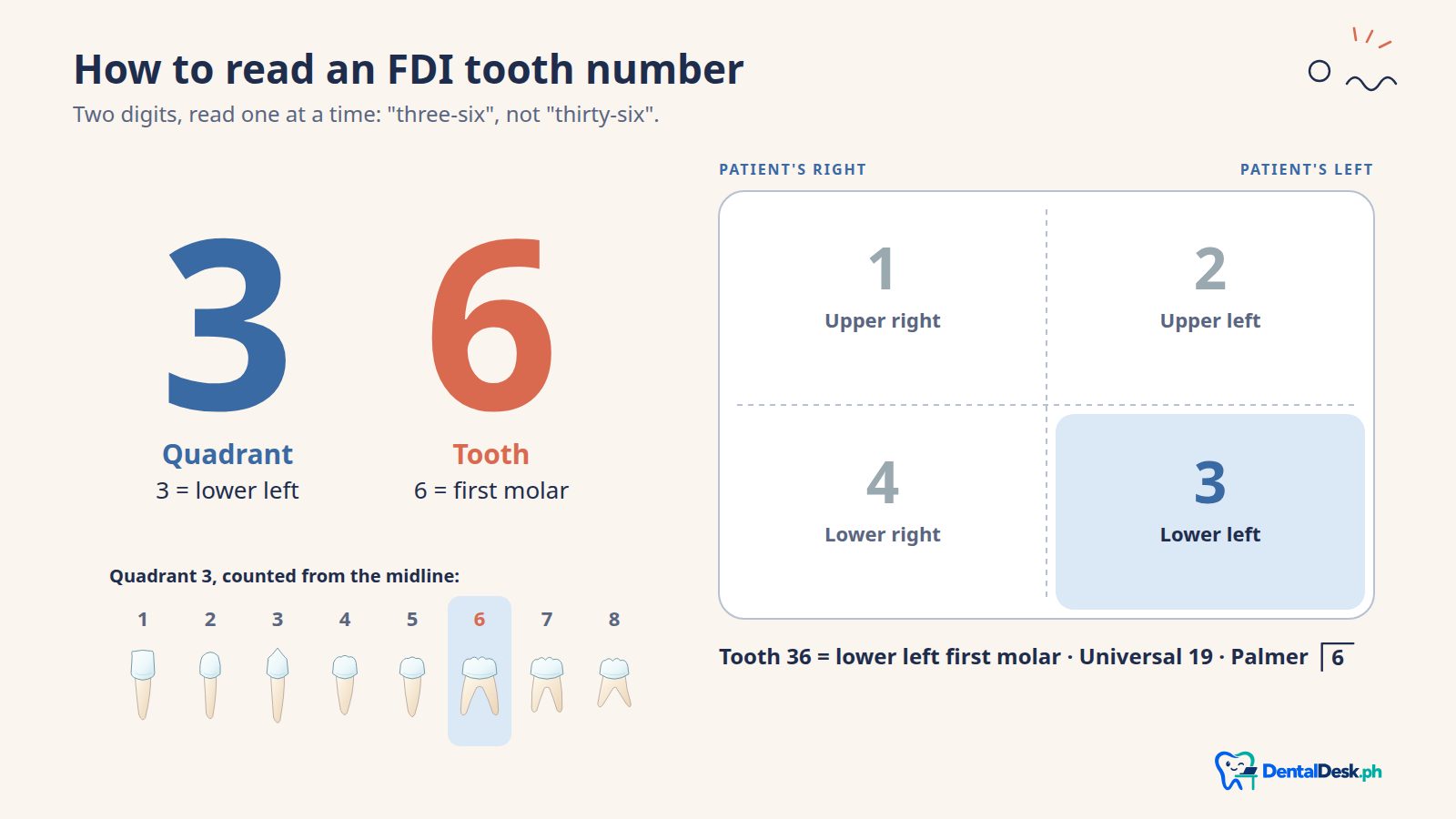
Read the two digits separately. Say tooth 36 as "three-six", not "thirty-six", so no one mistakes it for a Universal number.
First Digit: The Quadrant
| Quadrant | Permanent teeth | Primary teeth |
|---|---|---|
| Upper right | 1 | 5 |
| Upper left | 2 | 6 |
| Lower left | 3 | 7 |
| Lower right | 4 | 8 |
The first digit also tells you whether the tooth is permanent (1 to 4) or primary (5 to 8).
Second Digit: The Tooth
Count from the midline toward the back of the mouth.
| Second digit | Permanent tooth | Primary tooth |
|---|---|---|
| 1 | Central incisor | Central incisor |
| 2 | Lateral incisor | Lateral incisor |
| 3 | Canine | Canine |
| 4 | First premolar | First molar |
| 5 | Second premolar | Second molar |
| 6 | First molar | |
| 7 | Second molar | |
| 8 | Third molar (wisdom tooth) |
Watch digits 4 and 5: in a permanent quadrant they are premolars, in a primary quadrant they are molars. Tooth 14 is a first premolar, while tooth 54 is a primary first molar.
Examples
| FDI number | Tooth |
|---|---|
| 11 | Upper right central incisor |
| 21 | Upper left central incisor |
| 13 | Upper right canine |
| 24 | Upper left first premolar |
| 36 | Lower left first molar |
| 46 | Lower right first molar |
| 48 | Lower right wisdom tooth |
| 51 | Upper right primary central incisor |
| 75 | Lower left primary second molar |
In FDI, the first digit says where the tooth is and the second says which tooth it is.
Universal Tooth Numbering System
The Universal system, also called the Universal/National system, is the one the American Dental Association uses on its dental claim form. It numbers the permanent teeth 1 to 32 in one continuous run.
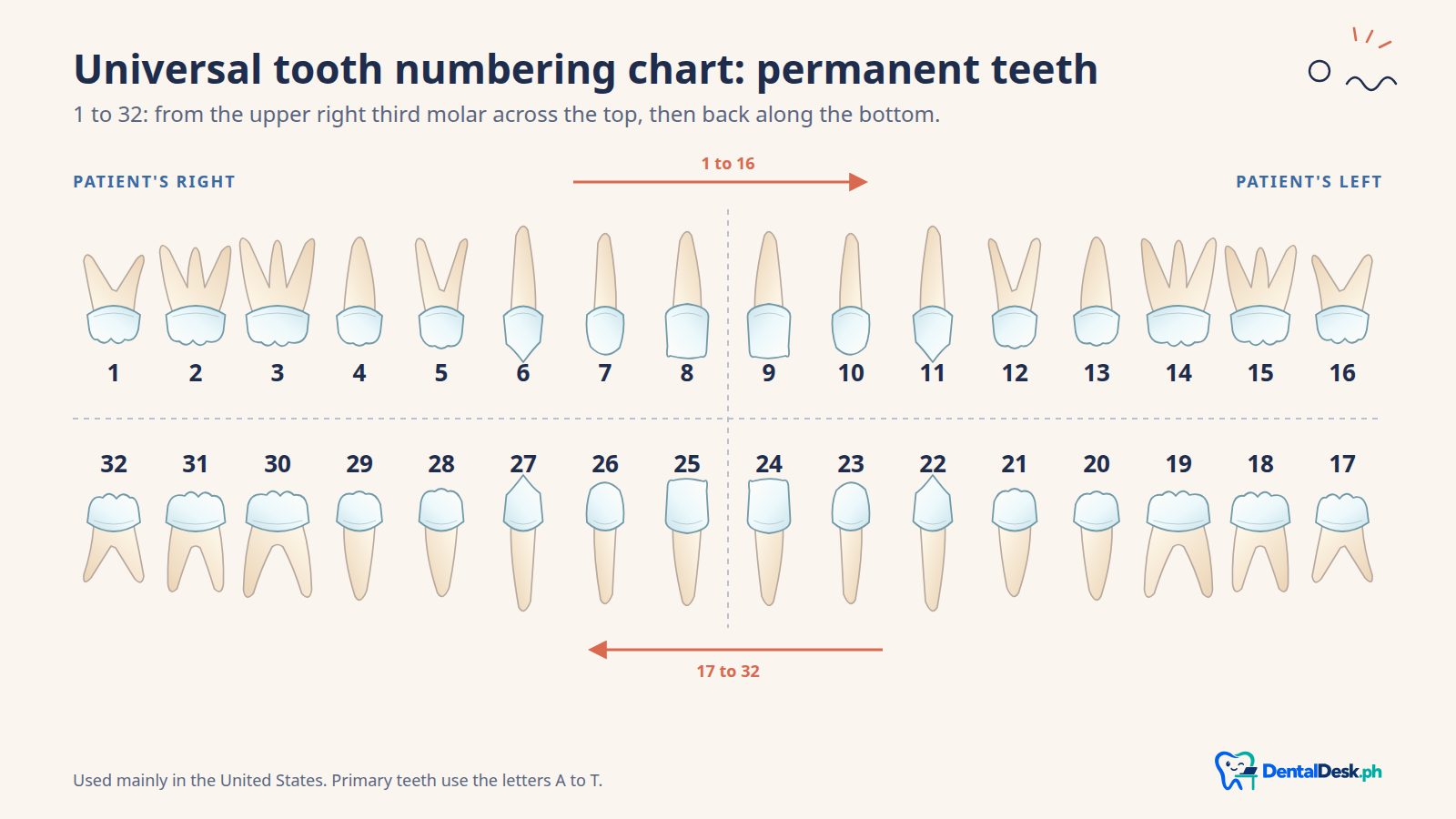
Counting starts at the patient's upper right third molar (1), runs across the upper arch to the upper left third molar (16), drops to the lower left third molar (17), and runs back to the lower right third molar (32).
| Patient's right | Patient's left |
|---|---|
| Upper right | Upper left |
| 1 2 3 4 5 6 7 8 | 9 10 11 12 13 14 15 16 |
| 32 31 30 29 28 27 26 25 | 24 23 22 21 20 19 18 17 |
| Lower right | Lower left |
Numbers worth remembering: 1, 16, 17, and 32 are the wisdom teeth, and 8 and 9 are the upper central incisors. A missing tooth keeps its number, so if tooth 1 was extracted, the next tooth is still 2.
Universal Primary Teeth
Primary teeth get the letters A to T, in the same order: A is the upper right second molar, J the upper left second molar, K the lower left second molar, and T the lower right second molar.
| Patient's right | Patient's left |
|---|---|
| Upper right | Upper left |
| A B C D E | F G H I J |
| T S R Q P | O N M L K |
| Lower right | Lower left |
The ADA also numbers extra (supernumerary) teeth: 51 to 82 for the permanent dentition, adding 50 to the number of the nearest tooth, and the nearest letter plus S for primary teeth, such as AS. These 51 to 82 numbers overlap FDI's primary codes, another reason to name the system on every record.
Palmer Notation System
Palmer notation, also called Zsigmondy-Palmer, numbers each quadrant 1 to 8 from the midline, like FDI, but shows the quadrant with a bracket instead of a digit. The bracket's two lines stand for the midline and the bite, so its corner always points to the center of the mouth. Primary teeth use the letters A to E.
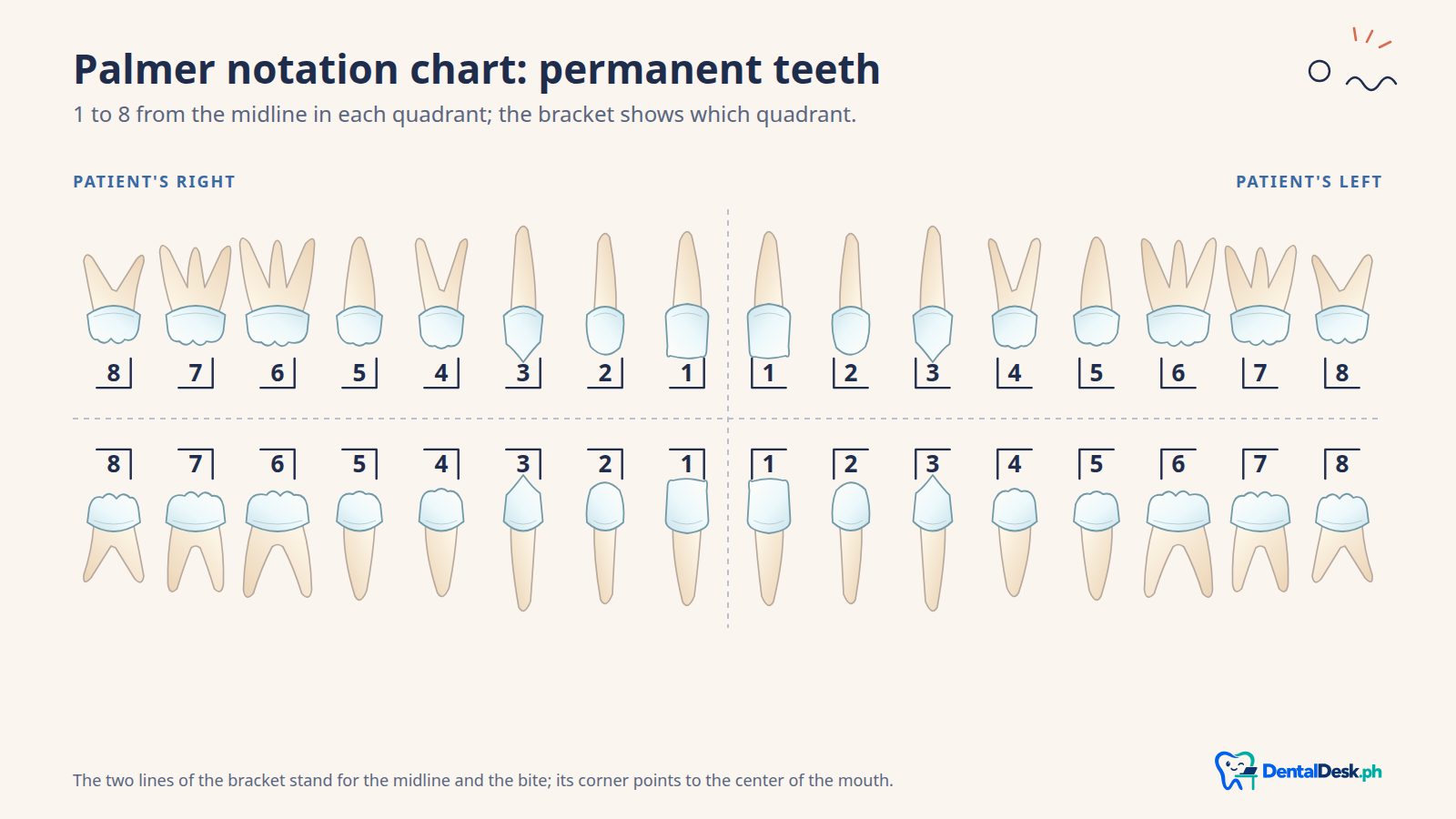
| Quadrant | Bracket | First molar | Written in text |
|---|---|---|---|
| Upper right | ┘ | 6┘ | UR6 |
| Upper left | └ | └6 | UL6 |
| Lower left | ┌ | ┌6 | LL6 |
| Lower right | ┐ | 6┐ | LR6 |
Because brackets are hard to type, letters, emails, and lab slips often write Palmer as UR6, UL6, LL6, and LR6. You will meet Palmer mostly in British dental records and in orthodontics.
Tooth Numbering Conversion Chart
Use these tables when a referral letter, a lab slip, an X-ray report, or a patient's record from abroad uses a different system than your clinic.
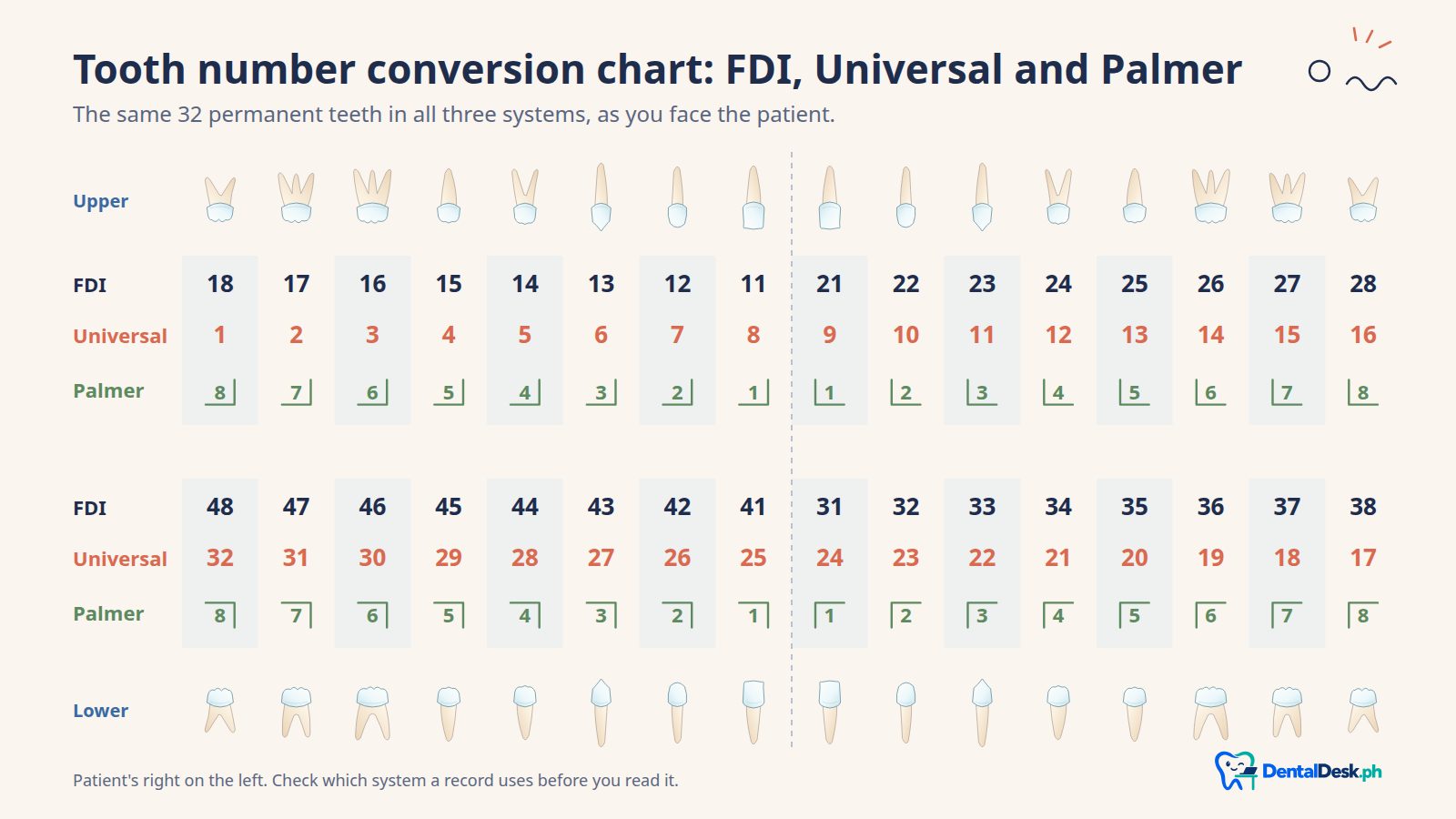
Quick Conversion From FDI to Universal
For permanent teeth, take the FDI second digit (the tooth, 1 to 8) and apply the rule for its quadrant:
| FDI quadrant | Universal number | Example |
|---|---|---|
| 1, upper right | 9 minus tooth | 16 becomes 3 |
| 2, upper left | 8 plus tooth | 26 becomes 14 |
| 3, lower left | 25 minus tooth | 36 becomes 19 |
| 4, lower right | 24 plus tooth | 46 becomes 30 |
Permanent Teeth
| Tooth | FDI | Universal | Palmer |
|---|---|---|---|
| Upper right third molar | 18 | 1 | 8┘ (UR8) |
| Upper right second molar | 17 | 2 | 7┘ (UR7) |
| Upper right first molar | 16 | 3 | 6┘ (UR6) |
| Upper right second premolar | 15 | 4 | 5┘ (UR5) |
| Upper right first premolar | 14 | 5 | 4┘ (UR4) |
| Upper right canine | 13 | 6 | 3┘ (UR3) |
| Upper right lateral incisor | 12 | 7 | 2┘ (UR2) |
| Upper right central incisor | 11 | 8 | 1┘ (UR1) |
| Upper left central incisor | 21 | 9 | └1 (UL1) |
| Upper left lateral incisor | 22 | 10 | └2 (UL2) |
| Upper left canine | 23 | 11 | └3 (UL3) |
| Upper left first premolar | 24 | 12 | └4 (UL4) |
| Upper left second premolar | 25 | 13 | └5 (UL5) |
| Upper left first molar | 26 | 14 | └6 (UL6) |
| Upper left second molar | 27 | 15 | └7 (UL7) |
| Upper left third molar | 28 | 16 | └8 (UL8) |
| Lower left third molar | 38 | 17 | ┌8 (LL8) |
| Lower left second molar | 37 | 18 | ┌7 (LL7) |
| Lower left first molar | 36 | 19 | ┌6 (LL6) |
| Lower left second premolar | 35 | 20 | ┌5 (LL5) |
| Lower left first premolar | 34 | 21 | ┌4 (LL4) |
| Lower left canine | 33 | 22 | ┌3 (LL3) |
| Lower left lateral incisor | 32 | 23 | ┌2 (LL2) |
| Lower left central incisor | 31 | 24 | ┌1 (LL1) |
| Lower right central incisor | 41 | 25 | 1┐ (LR1) |
| Lower right lateral incisor | 42 | 26 | 2┐ (LR2) |
| Lower right canine | 43 | 27 | 3┐ (LR3) |
| Lower right first premolar | 44 | 28 | 4┐ (LR4) |
| Lower right second premolar | 45 | 29 | 5┐ (LR5) |
| Lower right first molar | 46 | 30 | 6┐ (LR6) |
| Lower right second molar | 47 | 31 | 7┐ (LR7) |
| Lower right third molar | 48 | 32 | 8┐ (LR8) |
Primary Teeth
| Tooth | FDI | Universal | Palmer |
|---|---|---|---|
| Upper right primary second molar | 55 | A | E┘ (URE) |
| Upper right primary first molar | 54 | B | D┘ (URD) |
| Upper right primary canine | 53 | C | C┘ (URC) |
| Upper right primary lateral incisor | 52 | D | B┘ (URB) |
| Upper right primary central incisor | 51 | E | A┘ (URA) |
| Upper left primary central incisor | 61 | F | └A (ULA) |
| Upper left primary lateral incisor | 62 | G | └B (ULB) |
| Upper left primary canine | 63 | H | └C (ULC) |
| Upper left primary first molar | 64 | I | └D (ULD) |
| Upper left primary second molar | 65 | J | └E (ULE) |
| Lower left primary second molar | 75 | K | ┌E (LLE) |
| Lower left primary first molar | 74 | L | ┌D (LLD) |
| Lower left primary canine | 73 | M | ┌C (LLC) |
| Lower left primary lateral incisor | 72 | N | ┌B (LLB) |
| Lower left primary central incisor | 71 | O | ┌A (LLA) |
| Lower right primary central incisor | 81 | P | A┐ (LRA) |
| Lower right primary lateral incisor | 82 | Q | B┐ (LRB) |
| Lower right primary canine | 83 | R | C┐ (LRC) |
| Lower right primary first molar | 84 | S | D┐ (LRD) |
| Lower right primary second molar | 85 | T | E┐ (LRE) |
Tooth Names and Numbers by Type
Each permanent quadrant holds the same eight teeth, so every tooth type has four FDI numbers that share a second digit.
| Tooth type | Teeth | FDI numbers | Universal numbers |
|---|---|---|---|
| Central incisors | 4 | 11, 21, 31, 41 | 8, 9, 24, 25 |
| Lateral incisors | 4 | 12, 22, 32, 42 | 7, 10, 23, 26 |
| Canines | 4 | 13, 23, 33, 43 | 6, 11, 22, 27 |
| First premolars | 4 | 14, 24, 34, 44 | 5, 12, 21, 28 |
| Second premolars | 4 | 15, 25, 35, 45 | 4, 13, 20, 29 |
| First molars | 4 | 16, 26, 36, 46 | 3, 14, 19, 30 |
| Second molars | 4 | 17, 27, 37, 47 | 2, 15, 18, 31 |
| Third molars | 4 | 18, 28, 38, 48 | 1, 16, 17, 32 |
Incisors cut, canines tear, and premolars and molars crush and grind.
Wisdom Teeth Numbers
Wisdom teeth are the third molars, the last tooth in each quadrant: 18, 28, 38, and 48 in FDI, and 1, 16, 17, and 32 in Universal. A wisdom tooth keeps its number whether it is erupted, impacted, or already extracted; the chart records its condition separately.
FDI vs. Universal vs. Palmer
All three systems name the same teeth. They differ in how they show the quadrant.
| Feature | FDI | Universal | Palmer |
|---|---|---|---|
| Permanent teeth | Two digits, 11 to 48 | 1 to 32 | 1 to 8 with a bracket |
| Primary teeth | Two digits, 51 to 85 | A to T | A to E with a bracket |
| Shows the quadrant | First digit | Position in the count | Bracket |
| Standard | ISO 3950, FDI | ADA | None |
| Where you meet it | Most countries, Philippines | United States | United Kingdom, orthodontics |
FDI suits typed and digital records: two digits hold both the quadrant and the tooth, and they are easy to dictate. Universal is what you will read on American records and textbooks, and Palmer on British ones. The best system for a clinic is the one its whole team and its referral partners read the same way.
Which System Do Philippine Dentists Use?
Dental records in the Philippines commonly use the FDI two-digit system. The University of the Philippines Health Service dental record (revised 2024), for example, charts permanent teeth 18 to 48 and primary teeth, which it calls temporary teeth, 55 to 85.
You will still meet Universal numbers in American textbooks and review materials, in records of patients treated abroad, and in some imported software and lab forms. Knowing how to convert keeps those records safe to use.
In DentalDesk.ph's dental chart, each clinic chooses FDI or Universal numbering in its settings, with FDI as the default. Every tooth is stored the same way either way, so switching changes only the labels, never the chart. Printouts and exports use the clinic's numbering, and a Universal printout says so on every tooth heading.
Tooth Numbers in Dental Charting
A tooth number names the tooth. To say where on the tooth, you add the surface:
| Letter | Surface | Where |
|---|---|---|
| M | Mesial | Toward the midline |
| D | Distal | Away from the midline |
| O | Occlusal | Biting surface of premolars and molars |
| I | Incisal | Biting edge of incisors and canines |
| B | Buccal | Toward the cheek, on back teeth |
| F | Facial | Outer surface; on front teeth, labial (La) |
| L | Lingual | Toward the tongue |
| P | Palatal | Toward the palate, on upper teeth |
With FDI numbers:
- 36 O: the biting surface of the lower left first molar.
- 46 MO: the mesial and biting surfaces of the lower right first molar.
- 16 MOD: mesial, biting, and distal surfaces of the upper right first molar.
- 21 M: the mesial surface of the upper left central incisor.
The surface says where a finding is, not what it is. For the symbols, color codes, and a step-by-step method, read our guide to dental charting.
Common Tooth Numbering Mistakes
Mixing Up Left and Right
A chart shows the patient as you face them, so the patient's right is on your left. Check the quadrant digit before you mark a tooth.
Mixing FDI and Universal
The same number can name two different teeth. FDI 11 is the upper right central incisor; Universal 11 is the upper left canine. FDI 36 is a lower molar; Universal 36 does not exist. Find out which system a record uses before you read it.
Mixing Primary and Permanent Teeth
A child with mixed dentition has both. Tooth 55 (upper right primary second molar) and tooth 16 (upper right permanent first molar) can sit side by side, and each needs its own entry.
Renumbering Around a Gap
Missing, extracted, or unerupted teeth never shift the numbers of their neighbors. The upper right first molar is 16 even when 14 and 15 are gone.
Sending a Bare Number
On a referral, a lab slip, or an extraction note, name the system and the tooth: "FDI 26, upper left first molar". The extra words cost a second and remove the doubt. Before any procedure, confirm the tooth against the patient's mouth and X-rays, not the number alone.
Write the system, the number, and the tooth name, and nobody has to guess.
Frequently Asked Questions
How Are Teeth Numbered 1 to 32?
That is the Universal system. Counting starts at the upper right third molar (1), runs across the upper arch to the upper left third molar (16), then continues from the lower left third molar (17) back to the lower right third molar (32).
What Is Tooth Number 36?
In FDI, tooth 36 is the lower left first molar, the first permanent molar to erupt in that quadrant, usually around age 6. Its Universal number is 19, and in Palmer it is ┌6 (LL6).
What Is Tooth Number 46?
In FDI, tooth 46 is the lower right first molar. Its Universal number is 30, and in Palmer it is 6┐ (LR6).
What Are Teeth 11 and 21?
In FDI, 11 and 21 are the upper right and upper left central incisors, the two large front teeth. In Universal they are 8 and 9.
Why Does FDI Skip Numbers Like 19 and 20?
The first digit is the quadrant and the second is the tooth, so after 18 (the last tooth of quadrant 1) the count moves to quadrant 2 and starts at 21. Numbers ending in 0 or 9 are not ordinary teeth in FDI.
How Many Teeth Do Children Have?
A full primary set has 20 teeth. Between about age 6 and 12 children have mixed dentition, a combination of primary and permanent teeth, and the count varies with each child.
Is the Tooth Numbering System the Same Worldwide?
No. FDI is the international standard and the one used in the Philippines, Universal is used in the United States, and Palmer appears mainly in the United Kingdom and in orthodontics. Always check which system a record uses.
What Is an Odontogram?
An odontogram is a diagram of the teeth used to record findings and treatment. The tooth numbering system names each tooth on it.
One System, Every Record
Once you read the quadrant first and the tooth second, an FDI number takes a second to place, and Universal and Palmer are only other names for the same teeth. Pick one system for your clinic, use it on charts, notes, referrals, and treatment plans, and keep the conversion table at hand for records that use another.
If you want a chart that does this for you, try DentalDesk.ph free for 3 months. Your clinic charts in FDI or Universal on a tablet at the chair, and the first clinic gets every feature, with no credit card needed.