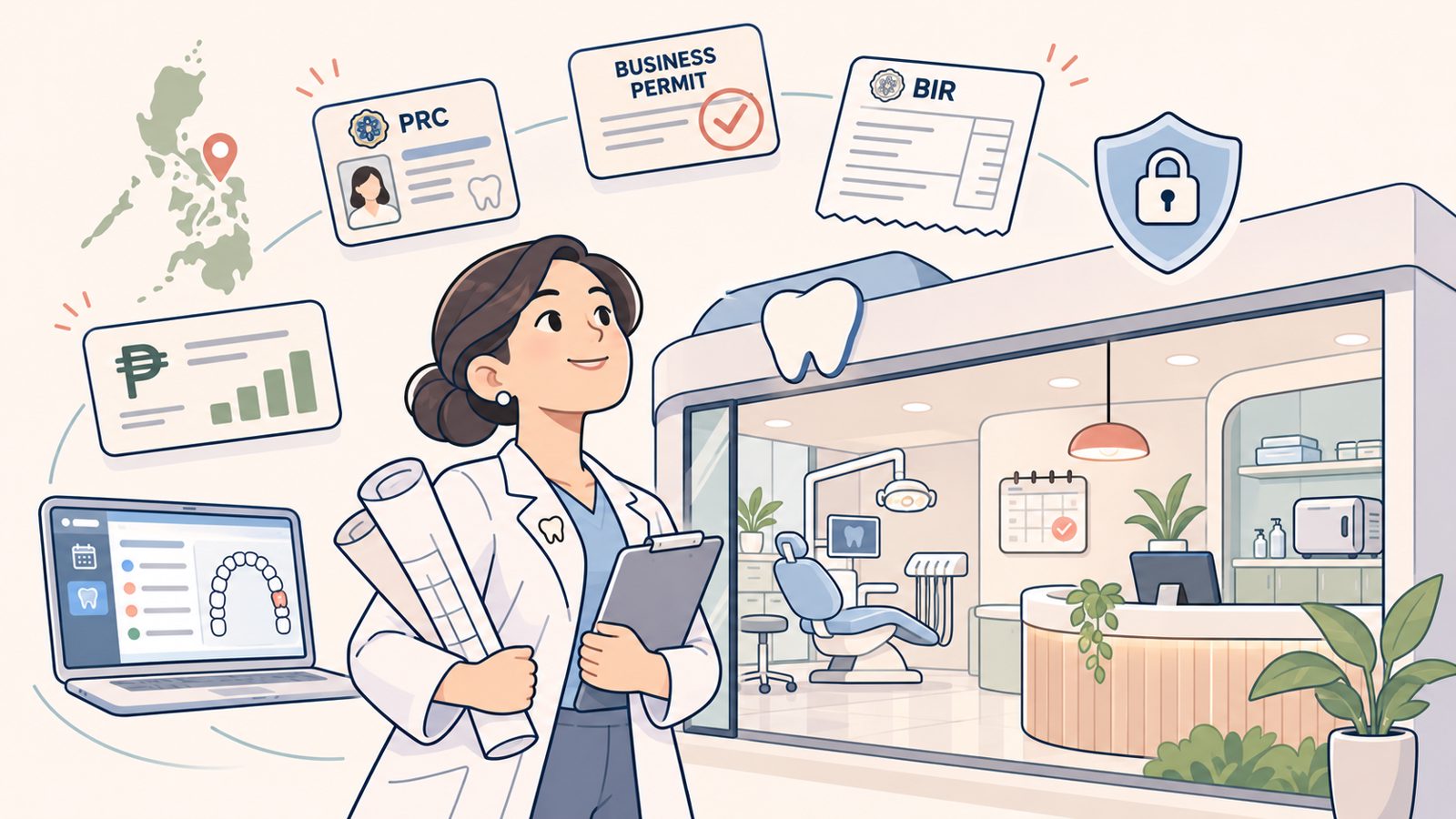
To open a dental clinic in the Philippines, you need a valid PRC dental license, a Professional Tax Receipt (PTR), the applicable business and BIR registrations, local government permits and clearances, and a clinic equipped for safe patient care. If you operate dental X-ray equipment, you also need the appropriate FDA authorization. Patient records must be managed in accordance with the Data Privacy Act of 2012 (RA 10173).
For a single-chair clinic, an illustrative startup budget ranges from around ₱1 million to ₱3.5 million, excluding major imaging equipment. Your actual investment will depend on your location, renovation requirements, equipment choices, services, and operating expenses.
The expensive mistakes in starting a dental clinic often happen before the first patient arrives: signing a lease before checking zoning, buying equipment before confirming installation requirements, and spending the entire startup budget without leaving enough money to operate.
This guide covers the registrations, permits, equipment, startup costs, and operating systems you need to prepare, in an order that helps you avoid those mistakes.
Dental clinic requirements in the Philippines: master checklist
Opening a dental clinic involves three separate responsibilities: your authority to practice dentistry, the registration and approval of your clinic, and the safe operation of your practice.
Having one does not automatically satisfy the others.
| Requirement | Responsible authority | Applicability |
|---|---|---|
| PRC Certificate of Registration and valid Professional Identification Card | Professional Regulation Commission (PRC) | Practicing dentists |
| Professional Tax Receipt (PTR) | Provincial or city treasurer | Dentists subject to professional tax |
| Business name registration | Department of Trade and Industry (DTI) | Sole proprietors using a registered business name |
| Partnership or corporate registration | Securities and Exchange Commission (SEC) | Applicable ownership structures |
| Barangay clearance | Barangay or LGU | According to the local permit process |
| Business or mayor's permit | City or municipal LGU | Subject to professional-practice rules and local ordinances |
| Zoning or locational clearance | LGU zoning office | According to the proposed clinic location |
| Sanitary permit | Local health office | As applicable to the establishment |
| Fire Safety Inspection Certificate | Bureau of Fire Protection (BFP) | As applicable to the premises |
| Building and occupancy documentation | Office of the Building Official | Depending on the premises and renovation work |
| BIR registration and invoicing | Bureau of Internal Revenue (BIR) | Professional practice or business |
| Dental X-ray facility license | Food and Drug Administration (FDA) | Clinics operating regulated X-ray equipment |
| Data privacy compliance | National Privacy Commission (NPC) framework | Clinics processing patient information |
| DPO and data processing system registration | National Privacy Commission (NPC) | Clinics meeting mandatory registration criteria |
| Employer registrations | SSS, PhilHealth, Pag-IBIG | Clinics employing covered workers |
Not every item requires a separate application for every clinic. Your ownership structure, municipality, equipment, and scope of services determine which requirements apply.
If you are opening a second branch, do not assume that the permits issued to your first location automatically cover the new one.
Your PRC license authorizes you to practice dentistry. It does not automatically authorize every premises, business activity, or piece of regulated equipment you intend to operate.
1. Confirm your professional license and obtain your PTR
Before looking for a clinic space, make sure your professional documents are in order.
PRC dental license
The practice of dentistry in the Philippines is governed by Republic Act No. 9484, also known as the Philippine Dental Act of 2007. If you are still on the way to your license, our guide on how to become a dentist in the Philippines covers the DMD program, the board exam, and registration.
Prepare your:
- PRC Certificate of Registration.
- Valid Professional Identification Card (PIC).
- Other professional credentials applicable to your services.
If you intend to hire associate dentists, verify their professional registration and license validity before they begin treating patients.
Use the Professional Regulation Commission website for official registration, renewal, and verification information.
Professional Tax Receipt (PTR)
A PTR is evidence that you have paid the applicable local professional tax.
Dentists generally obtain their PTR from the province or city where they practice, or where they maintain their principal office if they practice in several locations.
Under Section 139 of the Local Government Code, professional tax is generally payable annually on or before January 31. Different timing applies to professionals who begin practicing later in the year.
The usual preparation includes:
- Valid PRC identification.
- Previous PTR, if applicable.
- Identification and other documents required by the local treasurer.
- Payment of the assessed professional tax.
Keep a copy of your PTR with your clinic's registration documents and monitor its annual renewal.
A PTR is not a BIR registration, business permit, or substitute for your professional license.
2. Decide what kind of dental practice you are opening
Your ownership structure affects how you register the clinic, sign the lease, pay taxes, manage liabilities, and bring in business partners.
Make this decision before registering a clinic name or entering into major contracts.
| Ownership arrangement | Registration consideration |
|---|---|
| Individual dentist practicing under their own name | Professional and tax registration, with applicable local requirements |
| Sole proprietor using a clinic business name | DTI business name registration |
| Partnership | SEC registration and appropriate partnership arrangements |
| Corporate business structure | SEC registration, subject to professional-practice and ownership restrictions |
DTI business name registration
If you are establishing a sole proprietorship under a clinic business name, use the DTI Business Name Registration System.
Registering a business name does not grant permission to practice dentistry or operate a clinic at a particular address. It is one part of the registration process.
Opening a clinic with another dentist
If two or more dentists intend to own the clinic together, settle the financial and management arrangements before committing capital.
Discuss:
- How much each owner contributes.
- Who owns the equipment and other assets.
- How expenses and income are divided.
- Who manages staff and administrative decisions.
- How additional capital will be raised.
- What happens if one owner leaves.
- How patient records and ongoing treatment obligations will be managed.
Consult a Philippine lawyer and accountant about the appropriate structure. Do not assume that an ordinary corporate registration permits an entity to engage in the regulated practice of dentistry.
Decide who owns the practice before deciding what to call it.
3. Check the clinic location before signing a lease
A space can look ideal for a dental clinic and still be expensive or unsuitable to convert.
Before paying a non-refundable deposit, contact the local Business Permits and Licensing Office (BPLO), zoning office, and other relevant authorities.
Confirm whether the address can accommodate your proposed clinic and what permits, inspections, and renovations will be required.
What to check during a site visit
| Item | What to verify |
|---|---|
| Zoning | Whether dental clinic operations are permitted at the address |
| Occupancy | Whether the existing building documentation supports the proposed use |
| Water supply | Whether the supply is reliable and suitable for the equipment |
| Drainage | Whether dental unit and other required drainage can be installed |
| Electrical capacity | Whether the premises can support the chair, compressor, sterilizer, air conditioning, and other equipment |
| Ventilation | Whether the space can support appropriate ventilation and infection-control arrangements |
| Accessibility | Whether patients can enter and move through the premises safely |
| Equipment access | Whether large equipment can be delivered and installed |
| X-ray installation | Whether the proposed imaging room can meet radiation protection requirements |
| Lease conditions | Whether the landlord permits renovation, plumbing, signage, and the intended clinical use |
Bring your dental equipment supplier or qualified contractor to the site before finalizing the lease. They can identify installation requirements that may not be obvious during an ordinary property viewing.
A cheap rental space can become expensive if it needs extensive plumbing, electrical work, structural modifications, or radiation shielding.
Questions to ask the landlord
Ask whether the lease permits dental clinic operations, who pays for permanent improvements, whether you can install external signage, and what happens to your renovations when the lease ends.
Also discuss whether the landlord will allow a fit-out period before regular rent begins.
Where possible, negotiate lease provisions that address failure to obtain the necessary permits or approval for the intended use.
Check the permits and installation requirements before signing the lease, not after the renovation begins.
4. Secure the applicable LGU permits and clearances
Dental clinic permits vary across Philippine cities and municipalities.
Your local Business Permits and Licensing Office should be your starting point for identifying the exact documentary requirements for your clinic.
Depending on your location, premises, and activities, these may include:
- Barangay clearance.
- Zoning or locational clearance.
- Business or mayor's permit.
- Sanitary permit.
- Fire Safety Inspection Certificate (FSIC).
- Building or renovation permits.
- Occupancy documentation.
- Signage permits and other locally required approvals.
Ask for the current official checklist and schedule of fees rather than relying on another dentist's experience in a different municipality.
Do dentists need a mayor's permit in the Philippines?
Dentists should distinguish between obtaining a local business permit and paying the business permit fee.
The Department of Finance's Local Finance Circular No. 001-2019 clarifies the local tax treatment of professionals who have paid their professional tax.
Under the circular, a professional who has paid the professional tax is generally exempt from the business permit fee for the clinic or office where they practice their profession.
A business permit may nevertheless be required and issued without the business permit fee under a duly enacted local ordinance. Other legitimate charges for services, inspections, or waste collection may still apply.
Activities outside the exercise of the profession, such as selling products, may also have different tax implications.
Find the circular on the Bureau of Local Government Finance's Local Finance Circulars page and confirm its application with your local treasurer and BPLO.
Does a dental clinic need a separate DOH license?
Do not assume that every standalone dental clinic has the same Department of Health licensing requirements as a hospital, primary care facility, or other regulated health facility.
The applicability of additional health facility licensing depends on how the facility is classified and the services it provides.
Confirm your proposed services with the appropriate DOH office, particularly if your clinic will offer additional services or operate as part of a larger healthcare facility.
Dental X-ray facility licensing is a separate matter covered later in this guide.
5. Register your dental practice with the BIR
Your dental practice needs the appropriate Bureau of Internal Revenue registration and tax administration arrangements, regardless of whether you operate as an individual professional or through an applicable business structure.
Arrange your BIR registration within the prescribed period and before commencing business as required.
BIR registration checklist for dentists
- Identify your applicable Revenue District Office (RDO).
- Prepare your professional identification and business registration documents, where applicable.
- Prepare the required clinic address documentation.
- Complete the appropriate taxpayer registration process.
- Obtain your BIR Certificate of Registration.
- Establish compliant invoicing arrangements.
- Register and maintain the required books of accounts.
- Identify applicable tax returns and filing schedules.
The BIR provides registration services through channels including its NewBizReg portal.
Understand your taxes before setting treatment fees
Depending on your registration and circumstances, your tax obligations may include income tax, percentage tax or VAT, withholding taxes, and employer-related filings.
Ask an accountant to explain which obligations apply to your practice and how much money you should set aside for them.
A clinic can appear profitable when you look only at patient collections. Once you account for laboratory expenses, consumables, rent, payroll, and taxes, the picture can be very different.
Maintain a separate account or clearly separated financial records for clinic income and expenses. Mixing personal spending with clinic funds makes bookkeeping and financial planning harder.
Prepare for senior citizen and PWD discounts
Dental services are covered by the senior citizen and PWD discount laws (RA 9994 and RA 10754). Qualifying patients are entitled to a 20% discount and, where applicable, VAT exemption on covered dental fees, whether your clinic is large or small.
Decide before opening how your front desk will check the ID, apply the discount, record it on the patient's bill and invoice, and keep the records your accountant needs.
Our guide to the senior citizen and PWD dental discount explains what is covered and how the discount is computed.
Patient billing is not the same as tax invoicing
A patient's balance in your dental clinic software tells you what the patient owes. A payment record tells you what the clinic collected.
Neither automatically replaces a BIR-compliant invoice.
Use your clinic management system for operational records and maintain the appropriate invoicing and accounting arrangements required by the BIR.
6. Design the clinic around how you will actually work
A dental clinic layout should support the movement of patients, dentists, assistants, instruments, supplies, and waste.
Start with the workflow, then design the interior around it.
A small clinic generally needs designated areas or suitable arrangements for:
- Patient reception and waiting.
- Dental examination and treatment.
- Instrument cleaning and sterilization.
- Clean instrument and supply storage.
- Clinical waste handling.
- Administrative work and patient records.
- Diagnostic imaging, if provided in-house.
The exact layout will depend on your space, services, equipment, and applicable requirements.
Follow an instrument through the clinic
Imagine completing a routine restorative procedure.
Where does the assistant place the used instruments? How are they transported for cleaning? Where are they packaged and sterilized? Where are clean instruments stored? How do they return to the treatment area?
If this workflow requires used instruments to repeatedly cross clean storage areas or patient waiting spaces, reconsider the layout.
Planning these movements before construction is easier than correcting them afterward.
Plan for future expansion
If you expect to add a second dental chair, another dentist, or imaging equipment, consider the future installation requirements while renovating.
You do not need to buy everything immediately. However, planning for suitable plumbing, electrical capacity, and available space can reduce the need to interrupt clinic operations later.
Have qualified professionals review the design and confirm its suitability for your intended services.
7. Buy dental equipment according to your services
A new dentist does not need to purchase every available dental instrument or machine.
Start with the procedures you are qualified to perform and intend to offer during the first year.
Essential dental clinic equipment checklist
| Category | Equipment and supplies |
|---|---|
| Dental treatment | Dental chair and unit, operating light, operator and assistant stools |
| Air and suction | Suitable compressor and suction system |
| Examination | Mouth mirrors, explorers, periodontal probes, and other examination instruments |
| Restorative care | Appropriate handpieces, curing light, restorative instruments and materials |
| Extraction and other procedures | Instruments appropriate to your planned services |
| Sterilization | Autoclave, instrument-cleaning supplies, packaging, and monitoring materials |
| Infection prevention | PPE, disinfectants, protective barriers, and hand hygiene supplies |
| Waste management | Suitable waste containers, sharps containers, and collection arrangements |
| Emergency preparedness | Appropriate emergency supplies and equipment based on professional standards and services |
| Administration | Computer or tablet, internet connection, printer where needed |
| Diagnostics | Examination tools and access to appropriate diagnostic imaging |
| Patient records | Dental charting, medical history, treatment planning, scheduling, and billing systems |
Compare the total cost of equipment ownership
When comparing dental chair packages or other major equipment, ask suppliers about more than the purchase price.
| Question | Why it matters |
|---|---|
| Is installation included? | Delivery and setup can increase the initial cost. |
| What does the warranty cover? | Warranty coverage may exclude particular components or services. |
| Are replacement parts available locally? | A broken component can interrupt treatment schedules. |
| Is preventive maintenance available? | Equipment needs ongoing servicing. |
| Is staff training included? | Your team must know how to operate the equipment properly. |
| What additional infrastructure is required? | Electrical, plumbing, ventilation, or construction work may be necessary. |
A lower-priced dental chair is not necessarily cheaper over its lifetime if parts are difficult to obtain or servicing takes several weeks.
Equipment you can consider buying later
Depending on your clinical scope and referral arrangements, you may be able to defer purchases such as:
- Panoramic X-ray or CBCT equipment.
- Intraoral scanners.
- Advanced implant equipment.
- Dental microscopes.
- In-house milling or other digital fabrication systems.
- Additional dental chairs.
Deferring a purchase is reasonable only when you can still provide appropriate care through suitable equipment, referral arrangements, and professional workflows.
Do not compromise on sterilization, infection prevention, or patient safety to reduce startup costs.
8. Obtain FDA authorization before operating dental X-ray equipment
If your dental clinic will operate an intraoral X-ray machine, panoramic X-ray equipment, or CBCT, investigate the applicable FDA licensing requirements before purchasing the machine.
Dental X-ray facilities are regulated through the FDA's Center for Device Regulation, Radiation Health, and Research (CDRRHR), under DOH Administrative Order No. 2020-0035.
The applicable authorization is separate from your professional dental license and ordinary local permits.
Dental X-ray licensing checklist
Depending on the equipment and authorization category, prepare to address:
- Facility and equipment documentation.
- Appropriate radiation shielding and room design.
- Personnel qualifications and professional credentials.
- Radiation protection officer arrangements.
- Recognized radiation protection training.
- Personnel radiation monitoring or dosimetry, where required.
- Equipment testing and quality assurance.
- Application, assessment, and inspection requirements.
Consult the FDA-CDRRHR Citizen's Charter for the applicable dental X-ray facility licensing process.
A machine's product registration or the supplier's authorization does not automatically authorize your clinic to operate the machine.
Can you open a dental clinic without an X-ray machine?
You can plan a practice that refers patients to an appropriately authorized dental imaging facility when diagnostic imaging is required.
This may reduce your initial equipment and construction expenditure.
Before opening, establish where patients will be referred, how imaging results will be received, and how the images and reports will be stored in their clinical records.
Review whether your referral arrangement adequately supports the services you intend to provide.
Decide whether to provide imaging in-house before finalizing the clinic layout. Radiation protection requirements can affect construction and startup costs.
9. Establish patient privacy and record management from day one
A dental clinic begins handling sensitive personal information as soon as it collects a patient's medical history or records their treatment.
Republic Act No. 10173, the Data Privacy Act of 2012, establishes obligations for organizations and individuals processing personal information in the Philippines.
Dental records can contain sensitive information, including:
- Medical and dental histories.
- Existing medical conditions and medications.
- Dental charts and treatment notes.
- Diagnostic images and clinical photographs.
- Patient identification and contact details.
- Treatment consent forms.
- Financial and payment information.
Whether these records are stored on paper, a computer, or an online dental clinic management system, the clinic must establish appropriate safeguards.
Data privacy checklist for a new dental clinic
- Designate a Data Protection Officer (DPO) or establish the appropriate DPO arrangements.
- Prepare a patient privacy notice.
- Identify the appropriate legal basis for each purpose of data processing.
- Collect only the information necessary for that purpose.
- Establish staff confidentiality procedures.
- Restrict patient record access according to job responsibilities.
- Use appropriate technical and physical security measures.
- Establish backup and recovery procedures.
- Define record retention and secure disposal policies.
- Establish procedures for patient rights requests and data incidents.
- Review your agreements with software providers and other service providers.
- Assess whether mandatory NPC registration applies.
A signed consent form does not, by itself, satisfy all Data Privacy Act obligations.
Does a small dental clinic need to register with the NPC?
Under NPC Circular No. 2022-04, mandatory registration applies to personal information controllers and processors meeting specified conditions.
These include organizations that:
- Employ 250 or more persons.
- Process sensitive personal information of 1,000 or more individuals.
- Conduct data processing that is likely to pose a risk to the rights and freedoms of data subjects.
A small dental clinic may have only three employees but maintain sensitive health records for more than 1,000 patients over time.
Staff count alone is therefore not enough to determine whether registration is required.
The risk-based criterion also deserves particular attention in healthcare settings. Do not assume that a clinic with fewer than 1,000 patient records is automatically exempt.
Review the NPC's official registration guidance and its procedures for mandatory registration or exemption.
Give staff access only to what they need
A receptionist may need to view appointments, patient contact information, and outstanding balances. That does not necessarily mean the receptionist needs unrestricted access to every clinical note or medical history.
A dentist needs clinical documentation, while an assistant's access should reflect their assigned responsibilities.
Individual accounts and appropriate access permissions help implement this separation.
DentalDesk.ph provides team permissions that allow clinic owners to configure access to different areas of the system. Its data privacy features describe how patient records are protected.
However, software permissions are only one part of privacy compliance. The clinic remains responsible for its policies, staff behavior, lawful data processing, and response to security incidents.
10. Prepare infection control, healthcare waste management, and staff procedures
Do not wait until opening day to teach your team how the clinic operates.
Establish written procedures for:
- Instrument cleaning, packaging, sterilization, and storage.
- Environmental cleaning and disinfection.
- Hand hygiene and personal protective equipment.
- Sharps handling and disposal.
- Healthcare waste segregation, storage, and collection.
- Occupational exposure and incident reporting.
- Medical emergencies and referral arrangements.
- Equipment inspection and maintenance.
- Supply inventory and expiry monitoring.
Arrange appropriate healthcare waste collection and disposal based on the types of waste your clinic generates and applicable environmental and local requirements.
Consult the Department of Health and relevant environmental and local authorities for applicable healthcare waste management guidance.
Register your employees
If you employ dental assistants, receptionists, or other covered workers, establish the applicable employer registrations and contribution arrangements with:
Also review employment contracts, applicable regional minimum wages, statutory benefits, payroll requirements, occupational safety obligations, and withholding taxes.
Have your staff practice the clinic's daily opening and closing routines before accepting patients.
Should a new dental clinic accept HMO patients?
HMO accreditation is optional, and it is a business decision rather than an opening requirement.
Accepting HMO members can bring patients to a new clinic, especially near offices whose employees have dental coverage. In exchange, the clinic agrees to the HMO's covered procedures and fee schedule, verifies each member's coverage and approval before treatment, and waits for the HMO to pay its claims.
Before applying, estimate how much of your expected patient volume HMO patients would represent and whether your cash flow can absorb delayed HMO payments.
Our explainer on HMO dental coverage in the Philippines describes how coverage works at the clinic, and the list of licensed HMOs in the Philippines shows which companies you may deal with.
How much does it cost to open a dental clinic in the Philippines?
The cost of opening a dental clinic depends mainly on the premises, renovation, equipment, services, and operating reserve.
A single-chair general dental clinic that refers patients for advanced imaging has a different startup budget from a multi-chair clinic with in-house panoramic X-ray or CBCT equipment.
The following budget models are illustrative planning scenarios, not verified supplier quotations or nationwide market averages.
Sample startup budget for a single-chair dental clinic
| Expense | Lower-budget scenario | Higher-budget scenario |
|---|---|---|
| Rental deposit and advance rent | ₱80,000 | ₱240,000 |
| Renovation and clinic fit-out | ₱250,000 | ₱800,000 |
| Dental equipment and instruments | ₱500,000 | ₱1,500,000 |
| Furniture, computer, and administrative equipment | ₱35,000 | ₱120,000 |
| Permits, inspections, and professional services allowance | ₱25,000 | ₱100,000 |
| Opening inventory and consumables | ₱15,000 | ₱80,000 |
| Working capital reserve | ₱180,000 | ₱600,000 |
| Total startup capital | ₱1,085,000 | ₱3,440,000 |
These examples exclude major in-house imaging equipment, financing costs, and additional site-specific expenses.
Your actual costs may fall below or above these scenarios.
Obtain written quotations for the dental equipment, installation, renovation, and other major expenses before committing your capital.
Three types of money you need to budget separately
A common budgeting mistake is treating every peso as money available for construction and equipment.
Divide your available capital into three categories.
Setup capital pays for renovation, equipment, permits, furniture, installation, and opening inventory.
Working capital pays for rent, salaries, utilities, supplies, and other operating expenses while patient collections are still developing.
Contingency funds cover unexpected construction work, equipment problems, delivery delays, and other unplanned expenses.
Keep these categories separate in your budget.
If you have ₱1.5 million available and spend ₱1.4 million getting the clinic ready, you have only ₱100,000 left to operate. A beautiful clinic does not solve that cash-flow problem.
Monthly operating expenses
Your startup budget should be accompanied by a monthly operating budget.
Here is an illustrative example for a small single-chair clinic:
| Monthly expense | Example budget |
|---|---|
| Rent | ₱30,000 |
| Staff compensation and employer costs | ₱35,000 |
| Electricity, water, and internet | ₱12,000 |
| Software and administrative services | ₱3,000 |
| Equipment maintenance allowance | ₱5,000 |
| Waste collection and other overhead | ₱5,000 |
| Estimated fixed monthly expenses | ₱90,000 |
Consumables, laboratory fees, transaction charges, taxes, loan repayments, and the dentist's own compensation are not included in this example.
At ₱90,000 in monthly fixed expenses, a three-month fixed-expense reserve would be ₱270,000. A six-month reserve would be ₱540,000.
These are planning targets, not mandatory capital requirements. Increase the reserve to account for other obligations and your expected patient volume.
Calculate your dental clinic's break-even point
Before opening, calculate how much patient activity the clinic needs to cover its operating expenses.
Break-even planning helps you evaluate whether your rent, staffing arrangements, treatment fees, and expected patient volume are financially realistic.
A worked break-even example
Assume the following:
| Financial assumption | Amount |
|---|---|
| Monthly fixed expenses | ₱90,000 |
| Average collected revenue per patient visit | ₱1,500 |
| Average variable cost per patient visit | ₱300 |
| Contribution per patient visit | ₱1,200 |
The contribution per visit is what remains after subtracting the variable cost from the collected revenue.
The simplified calculation is:
Break-even patient visits = Monthly fixed expenses ÷ Contribution per visit
In this example:
₱90,000 ÷ ₱1,200 = 75 patient visits per month
If the clinic operates 22 days per month, it needs approximately 3.4 patient visits per operating day to cover the modeled fixed expenses.
| Patient visits per month | Contribution after variable costs | Result after fixed expenses |
|---|---|---|
| 50 | ₱60,000 | -₱30,000 |
| 75 | ₱90,000 | ₱0 |
| 100 | ₱120,000 | ₱30,000 |
| 150 | ₱180,000 | ₱90,000 |
This is a simplified operating break-even model. It does not include the dentist's compensation, taxes, loan repayments, depreciation, or recovery of the original startup investment.
Your own calculation should include the costs and income requirements relevant to your practice.
Use average collected revenue rather than the total value of treatment plans presented to patients. A treatment plan worth ₱30,000 does not mean the clinic has collected ₱30,000.
Also account for missed appointments, laboratory expenses, installment payments, and changes in the types of treatments performed.
Once the clinic is open, compare the model with what actually happens: record your expenses as they occur and review collections against them each month. DentalDesk.ph's insights and expenses put those figures side by side.
Know how many patient visits your clinic needs to survive before deciding how much rent it can afford.
Set up your dental clinic management software before opening
A new clinic has an advantage that established practices often do not: it can start with organized digital records instead of migrating years of paperwork later.
Choose how you will manage patient records, appointments, dental charts, treatment plans, and payments before accepting your first patient.
What a new dental clinic needs from its software
| Clinic activity | Software capability to evaluate |
|---|---|
| Registering a new patient | Patient profiles and medical histories |
| Recording examination findings | Dental and periodontal charting |
| Planning treatment | Treatment plans and estimated costs |
| Booking appointments | Shared calendar and scheduling |
| Recording payments | Billing and patient balances |
| Documenting clinical care | Treatment notes and patient history |
| Receiving diagnostic information | Image and document attachment handling |
| Managing staff | Individual accounts and access permissions |
| Protecting records | Security, backup, recovery, and data export arrangements |
When comparing dental software in the Philippines, evaluate how well the system fits the clinic's actual workflows, rather than choosing solely by the number of advertised features.
Also review the provider's privacy arrangements, terms, data handling practices, and options for accessing or exporting records if you change systems.
DentalDesk.ph is dental clinic management software built for Philippine dental practices. It brings together patient records, medical histories, dental charting, treatment plans, appointment scheduling, billing and balances, and staff permissions.
Its dental charting feature supports clinical documentation using the DOH dental charting legend, while the clinic calendar helps the team coordinate appointments. If you are new to charting conventions, our guide to dental charting symbols is a useful refresher for your team.
A new clinic also needs a way for patients to find and book it. Our article on why online booking matters for dental clinics covers what to consider.
Test one complete patient visit
Before opening, run a simulated appointment with your team using fictional patient information.
Follow the entire workflow:
- Register the patient.
- Record their medical and dental history.
- Add examination findings to the dental chart.
- Prepare a proposed treatment plan.
- Record the treatment provided.
- Record a payment and follow the clinic's invoicing process.
- Schedule a follow-up appointment.
- Review the completed patient record.
Ask the assistant and receptionist to perform their own responsibilities using their individual accounts and access permissions.
This exercise can reveal missing forms, confusing responsibilities, incorrect permissions, and administrative problems before real patients encounter them.
Dental clinic opening timeline: what to do and when
You can complete several opening tasks in parallel, but some decisions depend on others.
Use the following sequence as a planning framework rather than a guaranteed permit-processing timeline.
| Phase | Main tasks | Before proceeding |
|---|---|---|
| 1. Practice planning | Confirm professional credentials, services, ownership, and budget | Define the type of clinic you are opening |
| 2. Site assessment | Check zoning, lease conditions, utilities, and equipment installation requirements | Confirm that the site can support the proposed clinic |
| 3. Registration | Arrange PTR, DTI or SEC where applicable, BIR, and local registrations | Identify all applicable authorities and requirements |
| 4. Fit-out and purchasing | Renovation, plumbing, electrical work, equipment procurement, and installation | Obtain required construction approvals before regulated work |
| 5. Operational preparation | Recruit staff, establish procedures, configure software, and order supplies | Prepare the team and patient workflows |
| 6. Inspections and authorizations | Complete required inspections, permits, and equipment licensing | Confirm permission to operate the applicable services |
| 7. Opening | Conduct simulated appointments and begin receiving patients | Complete the final readiness checklist |
The most important dependencies are the site assessment before the lease, the equipment requirements before construction, and the necessary authorizations before clinical operation.
Opening a second dental clinic branch
A second branch is not simply a duplicate of your first clinic.
Review the registration, licensing, staffing, and operational requirements for the new address.
In particular, confirm:
- Whether additional business registration or amendments are required.
- The new location's LGU permits and clearances.
- The applicable BIR branch registration and invoicing arrangements.
- FDA authorization for X-ray equipment at the new facility.
- Staff assignments and professional credentials.
- Patient record access and responsibilities between branches.
- Privacy and security arrangements across locations.
- Separate operating budgets and financial performance tracking.
Your existing PTR, business registration, or equipment authorization may not automatically satisfy every requirement of a new branch.
Establish how patients receiving treatment at multiple branches will have their clinical histories, appointments, outstanding balances, and ongoing treatment plans managed.
Seven expensive mistakes to avoid when opening a dental clinic
1. Signing the lease before checking the permits
Verify zoning, occupancy, landlord approval, and infrastructure before committing to the premises.
2. Buying equipment before planning the layout
A dental chair, compressor, autoclave, and X-ray machine have different installation requirements. Coordinate equipment selection with the contractor.
3. Assuming every LGU follows the same process
Professional tax rules apply nationally, but local documentary requirements, ordinances, and approval procedures can differ.
4. Spending all available capital on the clinic interior
Preserve working capital and contingency funds. The clinic still needs to pay rent and salaries after construction is complete.
5. Buying advanced equipment without a clear need
Consider whether the expected clinical demand, maintenance costs, training, and licensing requirements justify the investment.
6. Treating patient data privacy as an afterthought
Establish privacy policies, staff permissions, secure records, and incident procedures before collecting patient information.
7. Waiting until the clinic is busy to organize its records
Set up appointment scheduling, dental charting, treatment notes, and billing workflows from the beginning.
It is easier to train three people on an established process than to reorganize hundreds of patient records after several months of inconsistent documentation.
Printable dental clinic opening checklist
Use this final checklist to track your readiness before opening.
Mark an item as not applicable only after confirming the relevant requirements.
Professional and business registration
- PRC dental license and professional registration are valid.
- Applicable Professional Tax Receipt has been obtained.
- Ownership structure has been established.
- DTI or SEC registration has been completed where applicable.
- BIR registration has been completed.
- Appropriate invoicing and bookkeeping arrangements are ready.
Location and government permits
- Proposed clinic use is permitted at the address.
- Lease permits dental clinic operations and renovations.
- Barangay and applicable LGU clearances have been secured.
- Business permit requirements have been satisfied.
- Fire safety and sanitary requirements have been satisfied.
- Applicable building and occupancy requirements have been satisfied.
- Additional health facility licensing requirements have been assessed.
Equipment and clinical readiness
- Dental chair and essential equipment are installed and tested.
- Necessary instruments and supplies are available.
- Sterilization equipment and procedures are ready.
- Infection prevention procedures are established.
- Healthcare waste disposal arrangements are established.
- Emergency procedures and appropriate supplies are available.
- FDA dental X-ray authorization has been secured, if applicable.
- External diagnostic imaging referral arrangements are ready, if needed.
Staff and patient records
- Staff responsibilities and employment arrangements are established.
- Associate dentists' professional credentials are verified.
- Applicable employer registrations are completed.
- Patient intake forms and medical history records are ready.
- Privacy notices and data protection procedures are established.
- DPO arrangements and NPC registration applicability have been assessed.
- Staff accounts and access permissions are configured.
- Backup and record recovery arrangements are established.
Financial and operational readiness
- Startup expenses have been recorded.
- Working capital reserve is available.
- Monthly operating budget has been prepared.
- Treatment fees and financial policies are established.
- Senior citizen and PWD discount procedures are ready.
- HMO accreditation decided, if any.
- Supplier and laboratory arrangements are confirmed.
- Appointment scheduling and billing systems are ready.
- A complete simulated patient visit has been performed.
- Outstanding regulatory requirements have been resolved before opening.
Keep copies of your permits, registrations, equipment documentation, insurance policies where applicable, and renewal records in an organized physical or digital compliance folder.
Record each document's issuing authority, registration number, issue date, expiry date where applicable, and responsible staff member.
Frequently asked questions
Can a newly licensed dentist open a dental clinic in the Philippines?
Yes. A newly licensed dentist with valid professional registration may establish a dental practice, subject to applicable business, tax, local government, and facility requirements.
Dentists must also practice within their professional competence and arrange appropriate referrals when necessary.
How much capital do I need to open a dental clinic?
For initial planning, the illustrative single-chair scenarios in this guide range from approximately ₱1.1 million to ₱3.4 million, excluding major imaging equipment.
Your actual requirements may differ substantially. Obtain local quotations and prepare a working capital budget before committing to the project.
Is DTI registration mandatory for dentists?
Not in every situation. The need for DTI registration depends on how the practice is structured and whether the dentist operates under a registered sole-proprietorship business name.
Partnerships and corporations use different registration arrangements, while an individual practicing under their own name may have different requirements.
Do dentists need both a PTR and a business permit?
A PTR establishes payment of professional tax. Local business permit requirements are a separate matter.
Under DOF Local Finance Circular No. 001-2019, qualifying professionals may be exempt from paying the business permit fee for the exercise of their profession. However, applicable local permits, inspections, and other legitimate charges may still be required.
Can I open a dental clinic without an in-house X-ray machine?
Yes, provided your services are supported by appropriate diagnostic arrangements and professional standards.
You can refer patients to an appropriately authorized imaging facility instead of purchasing and operating your own X-ray equipment.
Does a dental clinic need an FDA license?
A clinic operating regulated dental X-ray equipment needs the applicable FDA facility authorization.
A clinic without X-ray equipment does not automatically require that same authorization. Additional FDA requirements may apply to other regulated activities.
Do dental clinics have to give senior citizen and PWD discounts?
Yes. Dental services are covered by RA 9994 for senior citizens and RA 10754 for persons with disabilities, so qualifying patients are entitled to the 20% discount and applicable VAT exemption on covered dental fees.
Is PhilHealth accreditation required to open a dental clinic?
PhilHealth provider accreditation is generally associated with participation in applicable PhilHealth benefit programs rather than being a universal prerequisite for opening an ordinary private dental clinic.
Employer registration and contributions for covered employees are separate obligations.
Are dental clinics covered by the Data Privacy Act?
Yes. Dental clinics process personal information and sensitive health information, bringing their data processing activities within the applicable Data Privacy Act framework.
Clinics must establish appropriate safeguards and assess whether mandatory NPC registration applies.
How long does it take to open a dental clinic?
There is no single timeline.
The duration depends on the suitability of the premises, local approval processes, renovation complexity, equipment delivery, staffing, and any additional facility authorizations.
Prepare your timeline around these dependencies rather than setting an opening date before identifying the required approvals.
What dental software should a new clinic use?
Look for dental clinic management software that supports patient records, medical histories, dental charting, treatment plans, appointment scheduling, billing, and appropriate staff access controls.
Philippine dental clinics can evaluate DentalDesk.ph alongside other available systems according to their clinical workflows, budget, privacy responsibilities, and administrative requirements.
Open a clinic that is ready to operate, not just ready to look open
A dental clinic is ready when the professional registrations are in order, the premises can operate legally, the equipment is safe to use, the staff know their responsibilities, and the practice has enough working capital to continue operating.
The interior design, signage, and equipment are visible parts of the investment. The systems behind them determine how consistently the clinic can operate.
Start with the requirements. Confirm the location before signing a lease. Purchase equipment according to your services. Protect your working capital. Establish patient record and administrative workflows before opening.
If you are preparing your first clinic or expanding to another branch, explore DentalDesk.ph's dental clinic management system to see how patient records, dental charts, appointments, treatment plans, and billing can work together from your first patient onward.
Official references and government resources
Research checked November 26, 2026.
- Professional Regulation Commission (PRC): professional registration, licensing, and renewal.
- Republic Act No. 9484: Philippine Dental Act of 2007.
- Republic Act No. 7160, Section 139: Local Government Code provisions on professional tax.
- Bureau of Local Government Finance, Local Finance Circulars: Local Finance Circular No. 001-2019 on the local taxation of professionals.
- DTI Business Name Registration System: sole proprietorship business name registration.
- Securities and Exchange Commission: partnership and corporate registration.
- Bureau of Internal Revenue: taxpayer registration, invoicing, bookkeeping, and tax obligations.
- BIR NewBizReg Portal: business and professional registration.
- Republic Act No. 9994: Expanded Senior Citizens Act of 2010.
- Bureau of Fire Protection: fire safety requirements.
- Department of Health: healthcare facility and public health guidance.
- FDA-CDRRHR Citizen's Charter: dental X-ray facility licensing, under DOH Administrative Order No. 2020-0035.
- National Privacy Commission: Data Privacy Act guidance and related issuances.
- NPC Registration FAQs: Data Protection Officer and data processing system registration under NPC Circular No. 2022-04.
- Social Security System: employer registration and contributions.
- PhilHealth: employer obligations and healthcare provider accreditation.
- Pag-IBIG Fund: employer registration and contributions.
This article provides general educational and business planning information. Regulatory requirements, application procedures, fees, and tax obligations may change or differ according to the clinic's location, ownership structure, equipment, and services. Confirm applicable requirements with the responsible government agencies and qualified Philippine legal, accounting, and healthcare professionals. Financial figures are illustrative planning examples, not supplier quotations or verified market averages.